

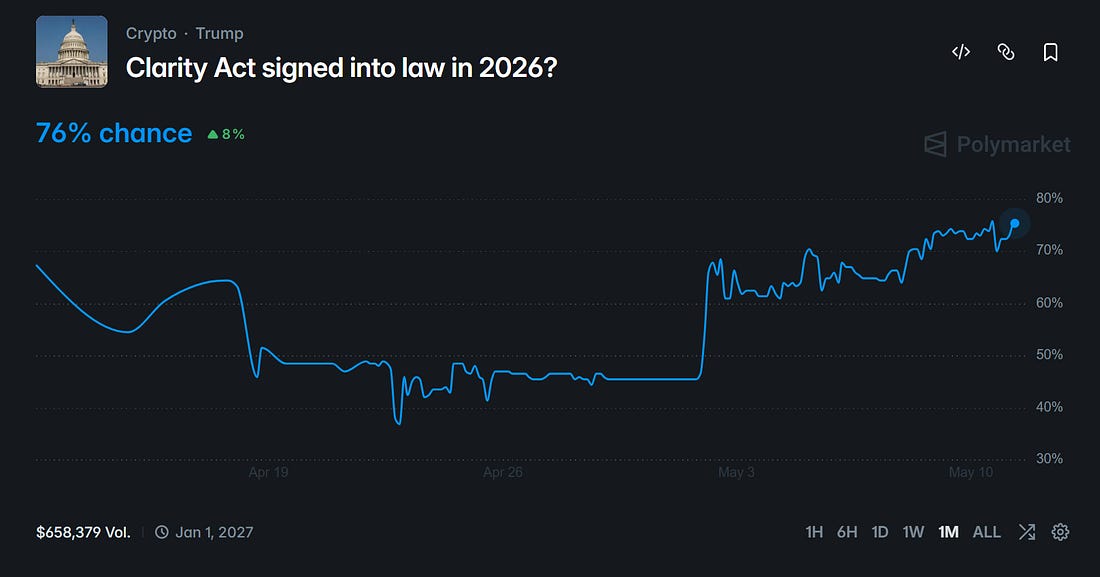
tl;dr Money flows like data on the web. Stablecoins are the default. The CLARITY Act hit 75% on Polymarket this week, up from ~45% at the start of the month. That is a probability backed by significant betting volume and real whip counting.
The bill creates a federal licensing framework for payment stablecoins. If it passes, the United States moves from regulatory hostility to structured permissibility in one legislative stroke. Regulated stablecoins are becoming the default settlement layer for autonomous agents. The next wave of crypto growth is software moving value at internet speed, not humans buying and holding tokens. The CLARITY Act forces stablecoin issuers into a regulated framework with reserve requirements, disclosures, and licensing. Banks enter the space confidently. Big tech builds payment integrations without legal risk. AI agents get programmable dollars backed by the same regulatory infrastructure as traditional bank accounts. Autonomous Software Moving Value At Internet SpeedOpen protocols like x402 and MPP are turning HTTP into a native payment rail. You’ve seen status codes like 404 not found on the internet, 402 was reserved 30 years ago for payment required and now it’s getting used. The x402 data tells a clear story, daily volume surged from $156,000 to $1.9 million in 30 days. The agentic economy is maturing from experimental micropayments to genuine economic activity. Nobody trusted the internet with their credit card in late 90’s. SSL certificates were obscure, Amazon was a bookstore and the idea of typing your card number into a website would have felt reckless. The same trajectory applies to autonomous agents. We do not trust AI with money yet. The systems are new, the failure modes are unknown, and the stakes feel high. But agents can already pay for APIs today. The infrastructure for trust layers, escrow mechanisms, and reputation systems is being built right now and they’ll eventually become reliable and trusted by the masses. Phase one is agents paying for API calls and compute. Phase two is where it goes mainstream. Think about your last few online purchases. Clothes, electronics, whatever. Right now you browse a retailer, read reviews, compare prices, and check what offers good value. In the future, that entire process gets delegated to an AI system. You set a budget and preferences. The agent finds the best products, compares reviews, checks delivery and pays.
You are probably not going to be comparing flight prices and airline options forever. That is a very good thing. What Builders Should Do NowThe regulatory window is closing fast. The May 14 markup is the next catalyst. If CLARITY passes, the stablecoin licensing framework locks in. Banks, custodians, and issuers start building on regulated dollar rails. The infrastructure race begins in earnest. Three areas capture the upside.
The builders positioning now will capture the upside. Agents are transacting, consolidating, and spending real money. The window to build for them is open. It will not stay open forever.
The CLARITY Act hit 75% on Polymarket — up 10% in a week — meaning stablecoin regulation is now the most probable legislative outcome in US crypto policy since Bitcoin ETFs. The bill creates a federal licensing framework for payment stablecoins, and 75% probability signals serious whip counting. If it passes, the US goes from regulatory hostility to structured permissibility in one legislative stroke. Coinbase, Circle, and every bank with a stablecoin pilot are already positioning. Second-order effect: regulated stablecoins become the default settlement layer for the agentic payments infrastructure that’s being built in parallel. Exodus launched an AI agent–focused stablecoin on Solana. XO Cash pairs a token with a software agent SDK, creating the first wallet-native structure where AI agents get their own onchain bank accounts. This is the clearest signal yet that the Solana x agentic payments thesis is moving from speculation to product. It directly competes with x402 on Base and Stellar’s Soroban agent payment rails — the three architectures are now in a race for developer mindshare. GitHub trending reflects the same rotation. ByteDance’s UI-TARS-desktop hit #1 (32k stars, multimodal AI agent stack), Anthropic’s financial-services repo held #2 (19k stars, agentic finance reference architecture), and addyosmani/agent-skills (38k stars, production-grade agent engineering skills) held #3. The platform shift — from chat interfaces to agent-native workflows — is happening in open source, not in press releases. On arXiv, a wave of agent-system papers dropped: Rubric-Grounded RL for structured LLM reasoning, CLI agent learning under selective observation, and a stark paper on the “Industrialization of Cyber Offense” — arguing agentic AI systems can already conduct offensive cyber ops at industrial scale, targeting enterprises and the Mittelstand (German mid-market). The defence gap is widening faster than any single CISO can patch. On-chain DeFi is rotating into Sui: four Sui-native protocols (Haedal, SpringSui, Bucket, Current) all posted 15-40% daily TVL gains. R25 (RWA on Pharos) hit +126% over 7 days. Yield capital is migrating to higher-velocity L1s while Ethereum TVL plateaus. Macro overhang remains: Strait of Hormuz disruption priced at 99.3% No through May 15 (unchanged), US-Iran peace deals across all timeframes at ≥95% No, WTI crude at $100 in May priced at 100% Yes. Kiyosaki is warning of a 2026 crash. The macro risk overlay has not moved — but crypto infrastructure keeps building through it.
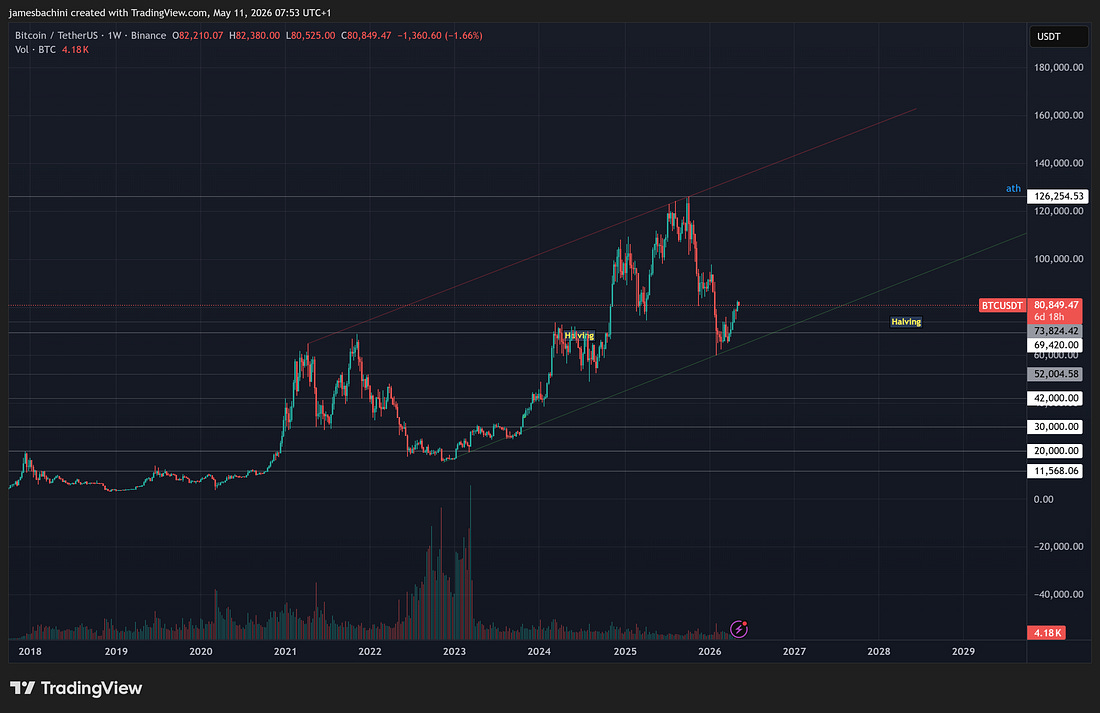
Grinding up and slowly recovering or at least showing signs of resuscitation. I wait, it’s what I do. Social links are below and if you enjoyed this newsletter I would appreciate it if you could share this content
|










0 Komentar untuk "The Agentic AI Payments Thesis"