

CLARITY Act & GENIUS Act: The Two Stablecoin Bills That Will Define The Future Of DeFiThe Blockchain Sector @ 2026-04-02
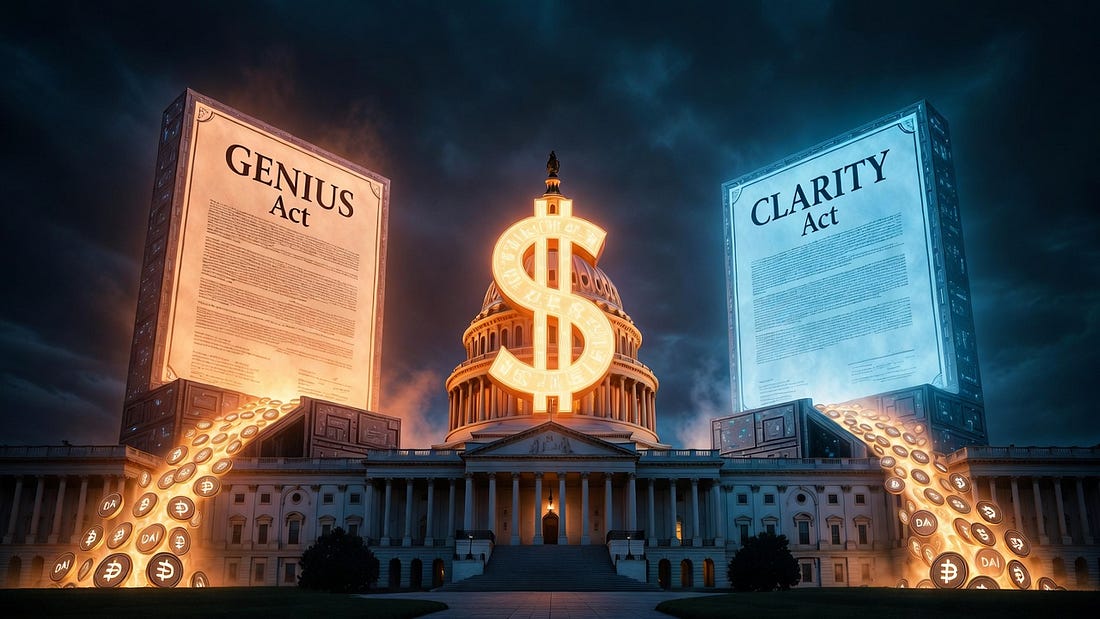
Two stablecoin bills which together will decide whether crypto becomes a payment layer or a complete alternate to the banking system. The contentious issue is yield. The next critical moment arrives in mid-April 2026, when the Senate holds its markup (a formal meeting where a congressional committee reviews, debates, amends, and votes on a bill) of the CLARITY Act, the key decision point where lawmakers will determine whether yield, including third-party rewards, is allowed or effectively banned. If the bill advances, it is expected to move through a Senate vote in May to June 2026, followed by a reconciliation process between House and Senate versions over the summer of 2026, where final compromises are negotiated. The process is likely to culminate in late summer or early autumn 2026, when a unified bill could be signed into law, completing the U.S. regulatory framework and deciding whether stablecoins function primarily as payment rails or evolve into yield-bearing financial instruments.
GENIUS ActThe GENIUS Act passed in July 2025 and made stablecoins regulated money under federal law. No more gray area. Here’s what it does:
The controversial part: stablecoins can’t pay interest or yield. Period. This isn’t a small detail. It’s the entire question the industry is fighting over. The GENIUS Act says stablecoins are digital cash, not savings accounts. That’s deliberate. It means your USDC can sit there as a dollar substitute, but it won’t earn you anything. CLARITY ActThe CLARITY Act is the market structure bill. It passed the House and is now stuck in the Senate. The markup is scheduled for mid-April 2026. What’s stuck? The same yield question. The CLARITY Act tries to fix the SEC vs CFTC turf war by creating clear jurisdictional boundaries:
For exchanges and builders, this means mandatory registration and disclosures. Consumer protection requirements come with it. The crypto platforms get pulled into a regulated financial system, whether they like it or not. But the real question keeping everyone up at night is this: the GENIUS Act bans issuer-paid yield. Does that close the loophole for exchanges, apps, and DeFi protocols that want to offer rewards on stablecoins anyway? The CLARITY Act tries to answer that. It potentially bans third-party yield distribution too. That’s the Senate’s current blocker. If the yield question stays open, exchanges and DeFi protocols keep offering yield. Stablecoins turn into synthetic bank accounts. Bank deposit flight becomes a real risk. The government loses some control and the fight over whether stablecoins are payments or savings. This is about more than crypto. It’s about who controls the digital dollar layer and how much of a risk DeFi is to traditional banking. Elsewhere the EU’s MiCA framework, UAE, and Hong Kong are all pushing regulatory clarity. If the U.S. doesn’t pass something, capital and innovation could move offshore. The CLARITY and GENIUS Acts together would create the first complete regulatory stack for digital assets in the United States. The April markup will tell us which way this goes. The question isn’t whether crypto gets regulated anymore. The question is what shape that regulation takes, and whether stablecoins can be controlled by the US policy makers.
News today from my morning briefing: (not sure if this is more or less useful that the curated links?) In the AI economy, VC investment hit a record $297B in Q1 2026, with 81% flowing to AI startups, an unprecedented concentration that Morgan Stanley warns could precede a transformative breakthrough “most of the world isn’t ready for.” The AI coding-tools arms race has become the dominant developer story: Claude Code is pulling 10.7K GitHub stars per day against OpenAI Codex at 2.4K, with entire plugin and multi-agent ecosystems forming around both in real time. But the security picture for AI agents is worsening — independent research found 26% of agent skills contain at least one vulnerability, and 341 malicious skills were discovered in a single ecosystem.
We’ve been in a fairly tight range since early February with Bitcoin bouncing around the $69,420 level (I bet I’m not the only one who has this marked on a chart) Saylor’s push doesn’t seem to have kickstarted the markets as we have settled in to a period of quiet ranging and reduced volatility. Iran is the key influence on markets currently and anything Trump says is affecting stocks and crypto. Significant set backs like the Drift hack ($270m lost to compromised admin keys) haven’t impacted the market substantially. Still feels like there is a lot of money on the fence waiting to be allocated into the next big thing. I’ve been the harshest critic of AI on the blockchain but that is starting to become a thing as x402 and MPP enable agentic AI systems to transact autonomously. Social links are below and if you enjoyed this newsletter I would appreciate it if you could share this content
|












0 Komentar untuk "CLARITY Act & GENIUS Act: The Two Stablecoin Bills That Will Define The Future Of DeFi"